



I had been a leader for years, but I had been in my first healthcare leadership job only a few hours when I first fully understood what I had signed up for.
The department I had been hired to lead was called “an absolute and total trainwreck” by the staff and administration. Within one week, the charge nurse handed me her resignation. She said, “Look, you seem like a nice guy, but this working environment has been unbearable for way too long. I just can’t do this anymore.” The next day, several more people turned in their resignations.
I was dumbfounded, shocked, and upset. How could they do this to me? They weren’t even giving me a chance. They owed it to me to give me time to fix this.
In my eagerness to be a great leader, I brushed their concerns aside too quickly. My focus was wrong… because it was first on myself, on what people would think of me.
I didn’t know then that I was about to learn a valuable lesson, a secret recipe, and the five largest challenges of leadership.
If you lead leaders, developing them isn’t just one of your jobs...
It’s the job.Everything else, your results included, is a byproduct.
Chances are you aren’t doing it yet.
And if you are... you might not be doing it well enough.
Why results are a byproduct
A team doesn’t get better on its own. It gets better through the people who lead it. When you improve the leaders who report to you, their teams get better and so do the results. I’ve watched it happen again and again. A leader I develop turns around and starts developing the leaders who work for them. That’s a seed that sprouts into a sapling that turns into an entire forest, and it all starts with you.

The opposite is true, too. A great leader whose team can’t perform likely loses their job. The results are the measurement, the team is what creates the results, and the team is only as good as the development the leader is providing (and getting).
So why doesn’t everyone focus first on people development? Because results are the main scorecard, and results are due now. When results are due now, development waits for a “less busy” month, and that month never comes.
What I did next
After those resignations, I stumbled across the secret recipe. I sat down one-on-one with each person who had resigned, and asked them what was wrong and how I could help.
I didn’t bring an agenda. I didn’t watch the clock. There was time to ask questions, listen to the answers, and give each person as much time and space as they needed.
That’s where the value was. I started to learn the magic that can happen in an uninterrupted one-on-one conversation. It can give you information that no other mode of communication can provide.
The answers they gave me as I met with them all sorted into five challenges. They wanted room to grow. They wanted the low performers dealt with. They wanted to feel like a team. They wanted their work to make sense. And they wanted the department to win.
I met with the entire team and committed to make improvements in every challenge, and I asked everyone who had resigned or was thinking of resigning to give me six weeks to show improvement. At the end of six weeks, everyone who had resigned took their resignation back.
I took what I learned with me when I went from leading frontline staff to leading leaders. The one-on-one meeting is still where I start anytime I get a new team or we are facing any sort of trouble.
What they wanted became what I later started to call the five leadership challenges: developing people, managing performance, building teams, improving operations, and achieving results.
What I mean by developing people
I don’t mean a general leadership program, course, or seminar. I mean what I learned in that first week in a department labeled a “trainwreck.” You meet one-on-one with your people. If you lead leaders, you meet one-on-one with each of those leaders every month.
You start by working through a set of questions together. There are usually seven to ten of these questions, and you walk through them with that leader, who answers in their own words. Here are some of the questions I commonly ask: What keeps you up at night? How do you think people describe you behind closed doors when you’re not there... and what would you want them to say? If we could wave a magic wand and grant you three leadership wishes, what would you want to be better at?
From those answers, you build a plan together. It’s their plan, so they help write it. You come back to it every month, and you hand them one small thing to try. Then you come back again and review what worked, what didn’t and where they got stuck. Then you rinse, wash and repeat.
It sounds simple because it is. The hard part is doing it every month, with every leader, when everything else is urgent. Trust me when I tell you I understand how difficult this is.
The leader they said I’d have to let go
Early in one of my executive leadership roles, I inherited a leader everyone expected me to fire. The word was that she couldn’t cut it, and it was time for her to move on. I didn’t take anyone’s word for it. I sat down with her one on one.
When I sat down with her, I realized she might be the best leader on the team, and she had what felt like unlimited upside. Nobody had sat down and done the analysis. What they were worried about had nothing to do with her skill... It was all about her confidence. Once she believed she could do it, all of her skill showed. She flourished, and she went on to develop many leaders. This is a direct example of how a seed became a sapling and then she developed an entire forest of leaders.
The five leadership challenges
As we go through them, you should picture each one starting with the word “keep”. Because the work on these five challenges never ends.
Challenge #1 - Developing people.
It can be difficult to find time to keep growing the people you lead. You must put a plan in place that the person helps write, and come back to it every month.
Don’t take anyone else’s opinion of a person at face value. Gather your own information. Gather your own evidence.
Potential Trap: waiting for a “less busy” month to get started.
Challenge #2 - Managing performance.
This struggle usually includes keeping expectations clear enough that nobody has to guess, and having the honest (and hard) conversations earlier rather than later.
When someone isn’t performing, you focus on developing them first. If you’ve made a real effort on development and they can’t or won’t improve, you have to move on.
Potential Trap: continuing to put the conversation off.
I have always believed this: What should be known eventually, should be known immediately.
Challenge #3 - Building a team.
This one increased the level of complexity, because it involves multiple people, interpersonal relationships and history that you may or may not know about.
Keeping a team that works together takes intentional design, not luck. People have to know you’ve invested in them before they’ll invest in each other.
Potential Trap: creating shallow team building that is more about being an event rather than team building as a habit.
Challenge #4 - Improving operations.
It is imperative as the leader that you work with the team to keep making the work better.
Ask your team, “What’s one silly obstacle that gets in your way every day?” Then trial a fix with a start date, an end date, and an evaluation period, and go back to the old way if the trial fix doesn’t work.
Potential Trap: Making changes without frontline input and not having an end date and an evaluation of a trial.
Challenge #5 - Achieving results.
This almost always feels like the most urgent challenge and being honest it is the challenge most likely to be how you are ultimately measured as a leader.
Results can’t always wait, so you need to have a plan to chase them from day one. But you won’t get lasting results by aiming at results alone.
Potential Trap: Allowing the pressure for results to take your focus away from the other four areas.
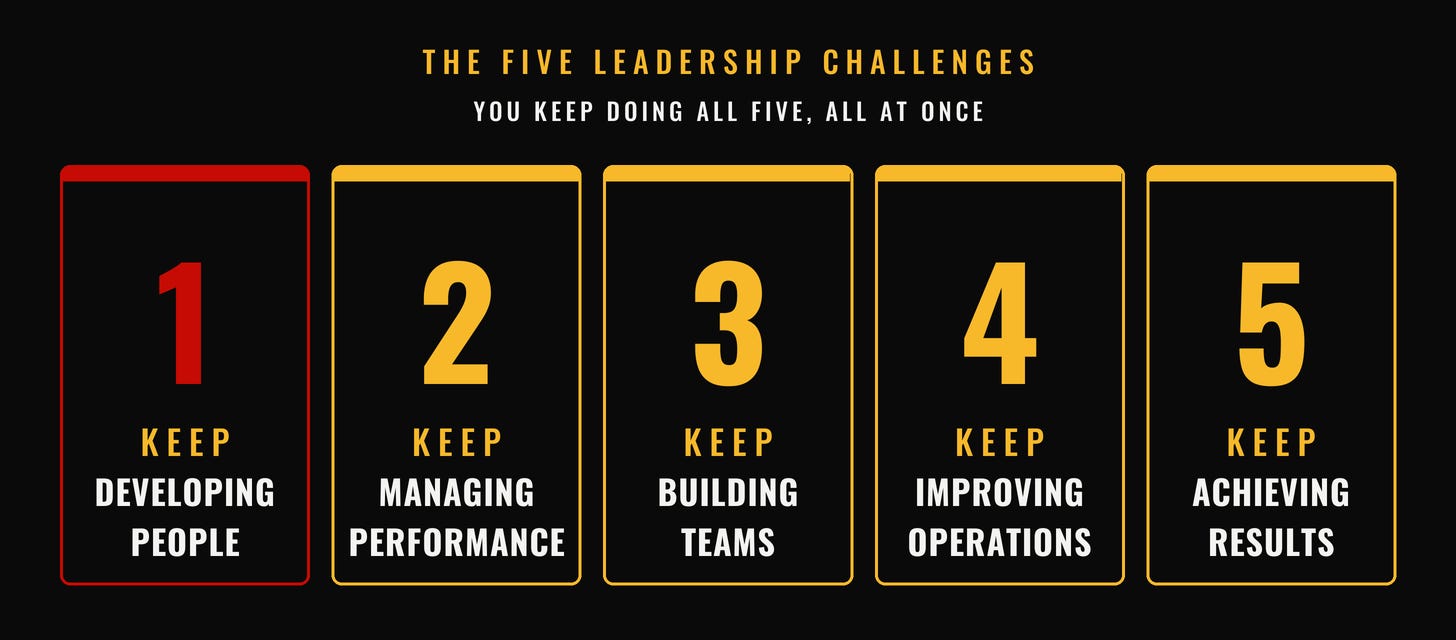
You must run all five
Developing people comes first, and it doesn’t come alone. You can’t spend a year developing people and then start on results. You’d be fired in six months… ninety days in some situations. So you have to find a way to run all five at once, from day one. Picture a person spinning plates on sticks. One plate is probably the easiest it’s ever going to be. We’re talking about five plates, each one needing a nudge before it wobbles off, all of them going at the same time. That’s the job of leadership. You are expected to do everything amazingly well, all at the same time.
Here’s the difference when you lead leaders. You don’t run all five areas yourself. You run them through the leaders you develop: their teams, their operations, their results. The better those leaders get, the less of the burden lands on you and the more time you have to develop them.
A challenge for this week
Write down the people on your team who lead others. Next to each name, write the last thing you did to help them develop as a leader. Where any line is blank, you’ve found a wobbling plate.
Then pick one of these leaders with a blank line, put thirty minutes on the calendar, and talk only about their development. Not the business.
That’s the main lesson I learned in my first week as a healthcare leader. Nothing moved until I met people where they were, one on one.